Three causes, and they are not equally serious. The first is a technique problem you can fix in ten seconds. The other two are reasons to leave the circuit off.
A breaker won't reset for one of three reasons: it was never pushed fully past the middle position to off, a short circuit or ground fault is still live on the circuit, or the breaker itself has failed. The first accounts for more cases than the other two combined.
Work them in that order and you will either restore power in ten seconds or learn something genuinely useful about the fault.
Why a breaker won't reset: three causes
What does it mean when a breaker will not reset?
Either the handle never reached the off position, so there is nothing to reset from, or the fault is still present and the breaker is doing its job by refusing to hold, or the mechanism itself has failed internally after repeated operation.
These are distinguishable by feel and by timing, which is what the rest of this page is about.
Ten-second fix first
The reset technique that actually works
01
Clear the circuit
Unplug every device on it, and switch off anything hardwired you can reach: lights, extractor fans, a garage door opener. The circuit must be genuinely empty.
02
Push fully to off
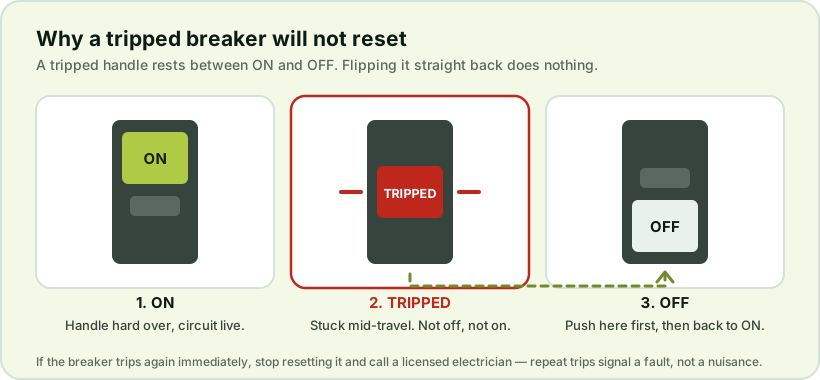
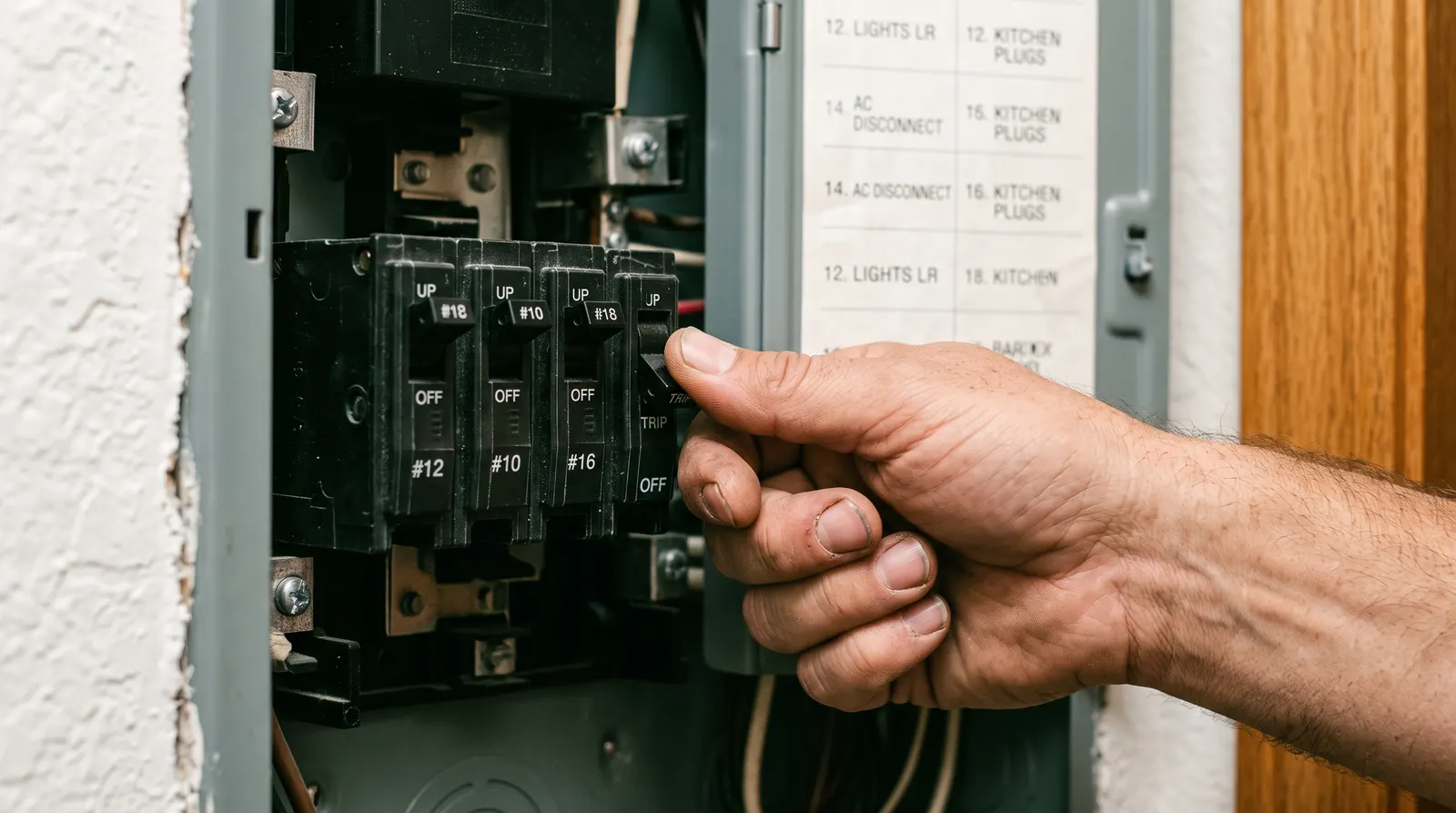
A tripped breaker rests in a middle position that looks close to on. Push the handle firmly past that centre point until it seats in off.
03
Then back to on
One firm movement. You should feel and hear it seat. Half-pressure from the middle position does nothing at all, which is what defeats most people.
04
Read the result
Holds: reintroduce devices one at a time. Trips instantly: a live fault. Will not move at all: a mechanical or internal failure. Each means something different.
Almost every "breaker won't reset" call that turns out to be nothing is this. The handle has three positions and people only expect two.
A tripped breaker rests between on and off. Pushing toward on from the middle position does nothing, which is why it feels like the breaker has failed when it has not.Source: Emergency Services 24H original diagram
Will not move, or trips back instantly?
These two symptoms get treated as one problem everywhere else, and they mean opposite things.
Will not move at all. The handle feels solid or spongy and does not seat. That points at the mechanism: an internal failure, or a breaker that has welded itself after repeated heavy tripping.
Seats, then trips back instantly. The breaker is working perfectly. Something on the circuit is drawing a fault current the moment power arrives, which means a short circuit or a ground fault.
Seats, then trips after a delay. That is an overload rather than a fault, and it is the least serious of the three.
Seats and holds, but no power. The breaker was not the problem. Look for a tripped GFCI upstream in the chain.
What an immediate re-trip proves
An instant re-trip on an empty circuit is one of the more definitive results in home electrics. Current is finding a path it should not have, and it is finding it in fixed wiring rather than in anything you can unplug.
That matters because it takes the problem out of homeowner territory entirely. There is no appliance to identify and no load to reduce. Something inside a wall, a ceiling or a junction box is faulted.
It also raises the stakes on further resets. ESFI attributes more than 28,000 home fires a year and over $700 million in property damage to arcing faults, and every reset re-energises whatever is arcing. Our page on why a breaker keeps tripping covers the diagnosis when the breaker does hold.
Stop resetting entirely if any of these are present
A burning or hot-plastic smell near the panel or anywhere on the circuit, a breaker that feels warm to the back of a finger, discolouration or scorching around the terminals, or buzzing and crackling from inside the panel. Any one of those means the fault has already produced heat. Leave the breaker off, do not open the panel, and call a licensed electrician tonight.
When the main breaker will not reset
This is a different problem wearing the same symptom, and the search results do not separate it.
A main breaker protects the whole installation, so when it refuses to hold you have lost the entire house rather than one circuit. The cause can be a genuine fault somewhere in the panel, a failed main, or something on the service side that belongs to your utility rather than to you.
Do not sit there resetting it. Switch off every individual breaker first so the main is not being asked to carry the whole house at once, then attempt one reset. If it still will not hold, call your power company and a licensed electrician, in that order.
Is it the breaker or the circuit?
How do I know if the breaker itself is faulty?
A breaker that trips below its rated load, feels warm, has a loose or spongy handle, or shows discolouration at its terminals is suspect. But a healthy breaker will also refuse to hold on a genuinely faulted circuit, so the circuit gets ruled out first.
The order of reasoning is the part that gets people hurt. Replacing a breaker because it will not hold, without establishing what it was interrupting, removes the protection rather than the problem.
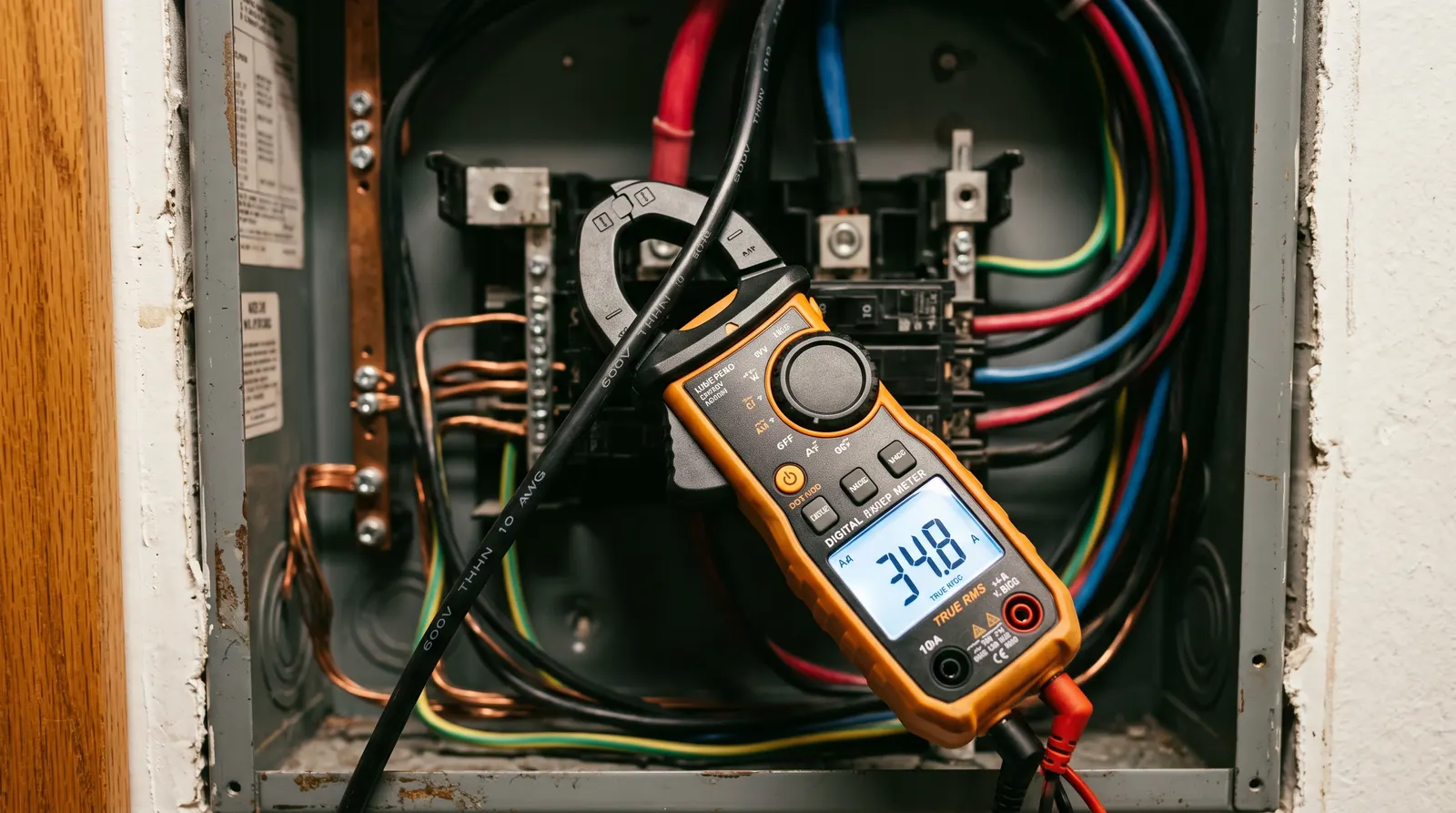
An electrician confirms the circuit is healthy, usually by disconnecting it at the panel and metering for continuity between conductors, before they conclude the device has failed. That sequence is why the diagnosis costs an hour rather than five minutes.
Leaving it off is a legitimate answer
There is an unspoken assumption in most of this content that the goal is to get the power back on tonight. Often it is not.
A circuit isolated at the panel is safe. If the affected circuit serves a spare bedroom or an outside socket rather than the fridge or the heating, the honest answer is to label the breaker, leave it off, and book a daytime appointment at half the hourly rate.
Write on a piece of tape and stick it over the handle. Households reset unlabelled breakers out of habit, and that is exactly the failure mode this page exists to prevent.
Power still off after a successful reset
If the breaker seats, holds and nothing works, the breaker was never the problem.
A tripped GFCI upstream. One GFCI receptacle protects everything wired downstream of it, and it is often in a different room. Check bathrooms, kitchens, garages, basements and outdoor sockets for test and reset buttons.
A switched outlet. Half a receptacle controlled by a wall switch that someone turned off. Common in living rooms and bedrooms.
A loose neutral. Power reaches the outlet and has no return path. This produces dead sockets with a live conductor present, which is why it is an electrician job rather than a poke-about job.
Pushing the handle fully to off and back to on, once
Unplugging every device on the circuit before retrying
Switching off hardwired lights and fans on that circuit
Hunting for a tripped GFCI in another room
Labelling the breaker and leaving it isolated
Call a pro now
Any breaker that trips back with the circuit genuinely empty
A main breaker that will not hold
Opening the panel cover or replacing any device inside it
A warm breaker, scorching, or buzzing at the panel
Dead outlets that persist after the breaker holds
24/7 dispatch network
Get a licensed electrician moving on this
A breaker that will not hold with the circuit empty, or a main that will not reset. Send the symptoms and your ZIP code and licensed, insured electricians covering your area will contact you directly. No obligation.
Fire, a gas smell, or an injury? Leave the building and call 911 first, then your gas
utility or power company. Use this form once you are safe.
Push the handle firmly all the way to OFF before resetting. A breaker reset from the tripped middle position often will not re-latch, which reads as a failed breaker.
What it costs to get this diagnosed
Indicative US ranges. Always get a written quote.
Job
Typical range
Notes
Service-call fee
$100–$200
Usually covers the first hour on site
Standard labor
$50–$130 / hr
Weekday business hours
Emergency / after-hours labor
$100–$250 / hr
Typically 1.5×–2× standard
Reported Saturday service call, breaker replaced
~$250
Trade-forum reported figure
Reported main-breaker replacement
~$90 / hr + parts, ~2 hrs
Trade-forum reported figure, standard hours
Source: HomeGuide 2026 electrician cost per hour; Angi 2026 electrician cost data; licensed-electrician reported figures from public trade-forum threads, marked as reported (retrieved August 2026). Figures vary by region, severity and after-hours timing.
Figures last checked
Two of those rows come from electricians discussing their own pricing on trade forums rather than from a cost aggregator, which is why they are labelled as reported. They are useful as a sanity check on a quote rather than as a rate card. Full detail sits in our guide to what an emergency electrician charges.
How the matching works, and what we do not do
Emergency Services 24H is a referral service. We do not employ electricians and we do not carry out electrical work.
Your request routes by ZIP code to licensed, insured contractors covering your area, and they contact you directly. Tell them whether the breaker trips back on an empty circuit, because that single detail tells them what kind of job they are coming to.
Straight answers
Frequently asked questions
The questions homeowners actually search for on this problem, answered in plain language.
Either it was never pushed fully past the middle position to off, which is the most common reason by a wide margin, or the fault it tripped on is still live. A short circuit or ground fault will trip a healthy breaker again the instant it is re-energised, however firmly you push the handle.
My circuit breaker won't turn on. What can I do?
Unplug everything on the circuit, then push the handle firmly all the way to off, past the middle position where a tripped breaker rests, and back to on. If it still refuses or trips back immediately with the circuit empty, stop. The remaining causes are a fixed-wiring fault or a failed breaker, both licensed work.
Why is my power not coming back after resetting the breaker?
The breaker is probably not the only protection in the chain. A tripped GFCI outlet upstream cuts power to every standard outlet downstream of it, often from another room. Check kitchens, bathrooms, garages, basements and outdoor receptacles for a device with test and reset buttons.
Is it okay to leave a breaker tripped?
Yes, and it is often the right decision. Isolating a faulty circuit at the panel is a legitimate holding action that lets the problem wait for a daytime rate instead of an after-hours one. Label the breaker so nobody in the household resets it, and do not use the circuit meanwhile.
How can I tell if a breaker is bad but not tripped?
A breaker that operates below its rated load, feels warm to the touch, has a loose or spongy handle, or shows discolouration around its terminals is suspect. Confirming it needs metering inside the panel, which is licensed work, and replacing a breaker before ruling out a circuit fault is the wrong order.
What if the main breaker will not reset?
That is a different problem from a single circuit and a more serious one. It can be a genuine fault on the main, a failed main breaker, or something on the service side that belongs to the utility. Do not attempt repeated resets. Call your power company and a licensed electrician.
The full-off reset
Clamp meter on the circuit
Unplug everything on the circuit, then try the reset. If it holds, the fault is in an appliance, not the wiring, and that changes who you call.
Tell us what has failed and where you are. We route your request to licensed, insured contractors covering your ZIP code, and they contact you directly.
Fire, a gas smell, or an injury? Leave the building and call 911 first, then your gas
utility or power company. Use this form once you are safe.