Not the homeowners policy, in almost every case, and not the tree owner's either unless negligence is in play. Here is the actual route, and the safety check that comes first.
A tree fell on car situation is a comprehensive auto claim in almost every case, not a homeowners one, and that holds regardless of whose property the tree stood on. Liability shifts to the tree owner only where negligence can be shown, which normally means a visibly dead tree that had been reported.
Tree fell on car: which policy pays
Home insurance or auto insurance?
Auto, specifically the comprehensive portion. Vehicles are covered by auto policies rather than property policies, so comprehensive is the route even when the car was on your own driveway and the tree was your own. Without comprehensive cover there is generally no first-party cover for the vehicle.
That single answer resolves most of the confusion on this topic, and it is stated inconsistently across the pages currently ranking for tree fell on car.
In the first few minutes
Four things before anyone touches the car
01
Check for lines before you approach
A tree big enough to crush a car is big enough to bring a service drop with it. Assume anything touching the tree or the vehicle is live and keep clear.
02
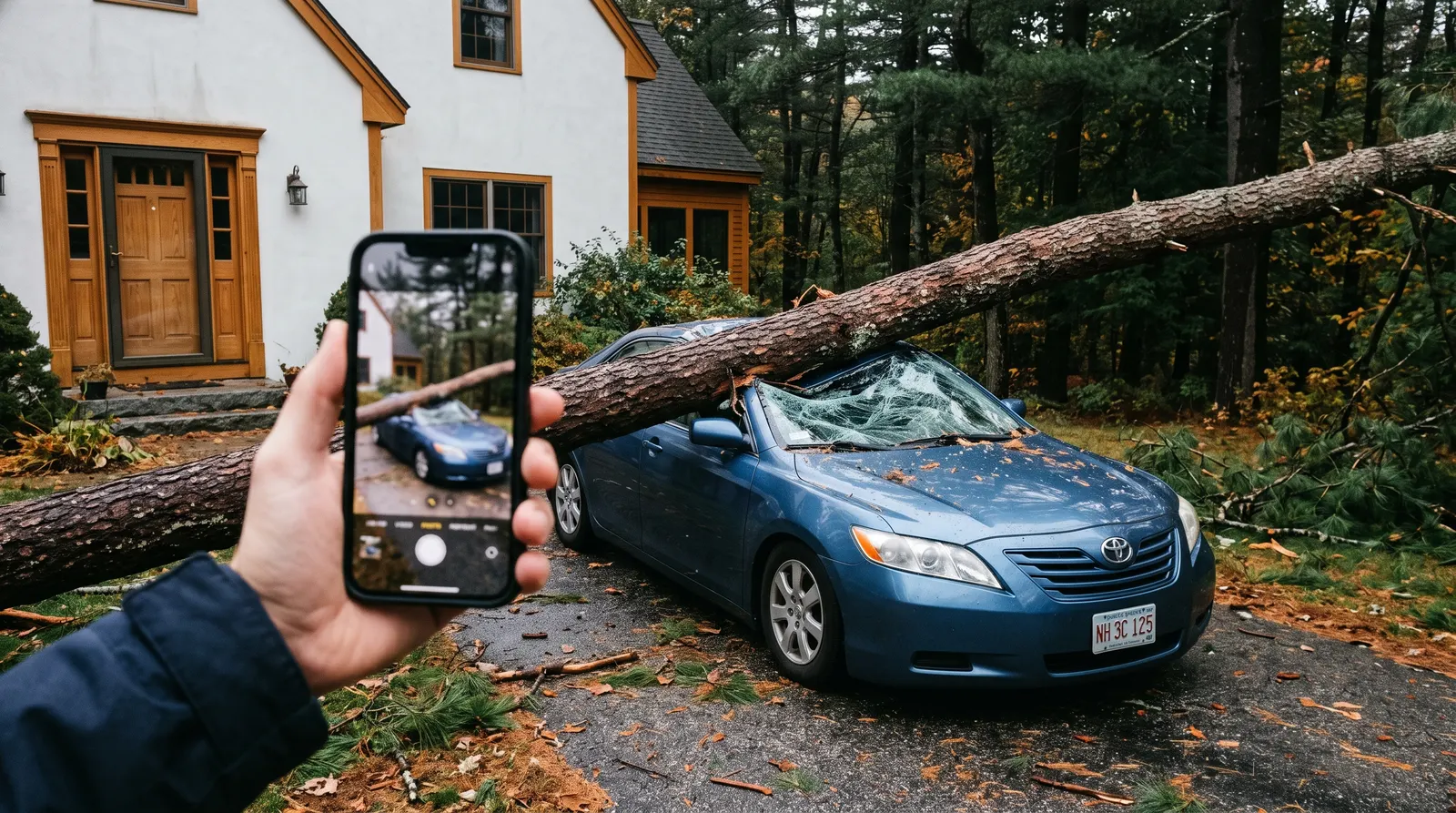
Photograph before anything moves
Wide shots showing the tree, the vehicle and the surroundings, close shots of the damage, and the base of the tree. Removal changes the scene permanently.
03
Call your auto insurer, not your home one
This is a comprehensive auto claim in almost every case, regardless of whose property the tree stood on or where the car was parked.
04
Retrieve your property before the tow
Documents, chargers, car seats and anything else in the vehicle. Once it goes to a yard, retrieving items becomes an appointment.
Before you touch the car
Lines first, always
A tree large enough to crush a vehicle is frequently large enough to bring a service drop or a distribution line down with it. Assume any line touching the tree, the car or the ground is live. Do not sit in the vehicle, do not try to move it, and do not touch anything the tree is touching. Call the utility and keep everyone clear.
CDC guidance on post-disaster electrical hazards is unambiguous on this, and it is the part a page about insurance claims usually skips entirely.
Photograph before removal starts
Wide shots showing the tree, the vehicle and where both are in relation to property boundaries.
Close shots of the damage: roof, pillars, glass, panels.
The base of the tree, which is where evidence of decay would be visible.
Date, time and weather, written down rather than trusted to memory.
The tree base photograph is the one people miss, and it is the only one that matters if a negligence argument comes up later.
Can you claim against the tree owner?
Sometimes, and the test is negligence rather than ownership.
A healthy tree brought down by a storm is generally treated as an act of nature, and the owner is not liable simply because it was their tree. A visibly dead or decaying tree that the owner knew about, particularly one that had been reported to them, is a different argument, and written evidence of that warning is what changes the outcome.
Where your own insurer pays and then pursues the other party, that is subrogation, and a successful recovery can mean your deductible comes back.
The municipal tree case
Claims against a city or county follow a formal notice process rather than an ordinary claim, and the deadlines are frequently short.
The negligence test does not change: a healthy public tree brought down by weather is generally not a liability, and a documented dead one that residents had reported is a stronger position. Document who you notified and when, and expect a slower process than an insurance claim.
Is the car totalled?
What decides a write-off?
A formula comparing estimated repair cost against the vehicle's actual cash value, with a threshold percentage set by state and by insurer. Roof and pillar damage is expensive relative to value, so tree impacts push older vehicles over that threshold quickly.
It is not a judgement call by the adjuster, which is worth knowing before that conversation. The variables are the repair estimate and the vehicle value, and both can be discussed.
Who removes the tree, and who pays
Two separate jobs get confused here: getting the tree off the car, and clearing the tree.
Lifting enough of the tree to recover the vehicle is normally part of the recovery. Clearing the rest falls to the property owner, and emergency removal typically runs two to three times standard rates, commonly quoted at $500 to $3,000 and above for storm work.
The wrinkle is that a vehicle is not an insured structure, so the homeowners debris removal cover that applies when a tree hits a house generally does not apply here. Our page on a tree that has hit the house covers that difference in detail.
Rental cover and what to do next
Check rental reimbursement on your policy, which is optional cover rather than standard.
Get the claim number and the adjuster contact details in writing.
Keep receipts for towing, storage and any transport you have to arrange.
Ask about storage fees, because a vehicle sitting in a yard accrues them daily.
Photograph everything before anything is moved. Once the tree is lifted, the evidence of what happened is gone.
What removal and the claim cost
Indicative US ranges. Always get a written quote.
Job
Typical range
Notes
Emergency tree removal
2x–3x standard rates
Storm work, commonly $500–$3,000+
Debris removal, no structure hit
generally not covered
A vehicle is not an insured structure
Comprehensive deductible
per your policy
Applies to the vehicle claim
Rental reimbursement
only if you carry it
Worth checking before you assume
Source: GoTreeQuotes 2026 emergency tree removal cost data and Insurance Information Institute debris removal guidance (retrieved August 2026). Figures vary by region, severity and after-hours timing.
Figures last checked
Row two is the one that surprises people. The tree that crushed your car does not trigger the debris removal cover that the same tree would trigger if it had landed two metres to the left, on the house.
How the matching works, and what we do not do
Emergency Services 24H is a referral service and not an insurance adviser. We do not employ tree crews and we do not handle vehicle claims.
Your request routes by ZIP code to licensed, insured contractors covering your area for the tree work, and they contact you directly. The vehicle side is a conversation with your auto insurer, and your policy is the authority on it.
What homeowners actually ask
What people ask, and what the sources say
Drawn from real public forum threads and reported prices, summarised and attributed as patterns.
These are not reviews of this site, and no names or ratings have been invented.
“Who is responsible if a tree falls on your car?”
SourceA People Also Ask question on this SERP. The answer is usually your own comprehensive cover, and the pages ranking here are mostly local news reports of storm damage rather than guidance.
“Can I sue the city if a tree fell on my car?”
SourceAnother People Also Ask question. Municipal claims follow a formal notice process with tight deadlines, and the same negligence test applies to public trees as to private ones.
“If the fallen tree did not hit an insured structure, there is generally no coverage for debris removal”
SourceInsurance Information Institute. That rule matters here because a car is not an insured structure, which shapes who pays to clear the tree itself.
1 / 3
The responsibility question dominates this search, and the answer is less dramatic than people expect. Your own comprehensive cover, your own deductible, and a negligence argument only where there is evidence for one.
Know the line
Handle it yourself, or call for help?
Safe to check yourself
Photographing the scene from a safe distance
Retrieving belongings once the area is confirmed clear
Contacting your auto insurer and opening a claim
Documenting the tree base and any evidence of decay
Checking your policy for rental reimbursement
Call a pro now
Any tree or vehicle in contact with a power line
Lifting or cutting any part of the tree
Recovering the vehicle from under the tree
Clearing the remaining tree and debris
Anything involving a leaning trunk still under tension
24/7 dispatch network
Get a licensed tree crew out
Tell us where the tree is and whether a power line is involved, plus your ZIP code. Licensed, insured contractors covering your area will contact you directly. No obligation to hire.
Fire, a gas smell, or an injury? Leave the building and call 911 first, then your gas
utility or power company. Use this form once you are safe.
Straight answers
Frequently asked questions
The questions homeowners actually search for on this problem, answered in plain language.
Your own comprehensive auto cover normally pays, regardless of whose property the tree stood on. Liability shifts to the tree owner only where negligence can be shown, which usually means the tree was visibly dead or decaying and the owner had been told about it.
Does homeowners insurance cover a tree falling on my car?
Generally no. Vehicles are covered by auto policies rather than by property policies, so the comprehensive portion of your auto insurance is the route even when the car was parked on your own driveway and the tree was your own.
Can I sue the city if a tree fell on my car?
Sometimes, and it follows a formal notice process with tight deadlines rather than an ordinary claim. The same negligence test applies: a healthy municipal tree brought down by a storm is generally an act of nature, and a documented dead one that was reported is a different argument.
Is a car totalled if a tree falls on it?
Often, because roof and pillar damage is expensive relative to vehicle value. Total loss is a formula comparing repair cost against actual cash value, with a threshold percentage set by state and by insurer. An older vehicle reaches that threshold with much less damage than a new one.
Who pays to remove the tree from the car?
Removal from the vehicle is usually part of getting the vehicle recovered, and the wider tree removal falls to the property owner. Emergency removal typically costs two to three times standard rates, commonly quoted at $500 to $3,000 and above for storm work.
What should I do before the car is moved?
Check for downed lines and stay clear if any are in contact with the tree or the vehicle. Then photograph everything: wide shots of the scene, close shots of the damage and the tree base, and the date, time and weather. Retrieve personal property before it is towed.
Documenting before it is moved
Comprehensive versus homeowners
Damage to a vehicle from a falling tree is a comprehensive motor claim, not a homeowners one, even on your own driveway.
Insurance Information Institute: What standard homeowners insurance covers, including storm perils and the ~$500 per-item cap on trees, shrubs and plants
Tell us what has failed and where you are. We route your request to licensed, insured contractors covering your ZIP code, and they contact you directly.
Fire, a gas smell, or an injury? Leave the building and call 911 first, then your gas
utility or power company. Use this form once you are safe.