Furnace won't turn on: four checks before you call anyone
Two of these four are switches nobody knows exist until a technician points at them and charges a diagnostic fee for the privilege.
A furnace won't turn on for one of four reasons in almost every case: it has no call for heat, no power, an unseated access panel, or a control-board lockout after failed ignition attempts. Working those four takes ten minutes and can save a $150 to $250 after-hours diagnostic fee.
Stop first if you can smell gas
A gas smell is not a troubleshooting situation
Sulphur or rotten eggs near the furnace means unburnt gas. Leave the building without switching anything on or off, including light switches, and call your gas utility emergency line from outside. Nothing on this page applies until that has been ruled out, and no amount of no-heat discomfort justifies staying to investigate.
Carbon monoxide is the other stop point, and it is harder because you cannot detect it. If a CO alarm has sounded, get everyone outside and call 911, as covered on our page about carbon monoxide from a furnace.
Furnace won't turn on: the four checks that fix most no-heat calls
What do I check when the furnace will not start?
Thermostat mode, setpoint and batteries. The furnace power switch, which looks like a light switch. The access panel, which must press a door interlock to allow power. Then the breaker, and finally a one-minute power cycle to clear a lockout.
Ten-minute check
Work them in this order
01
Thermostat
Mode on heat, setpoint several degrees above room temperature, fresh batteries. A thermostat with dying batteries often shows a display and still fails to close the circuit.
02
The furnace power switch
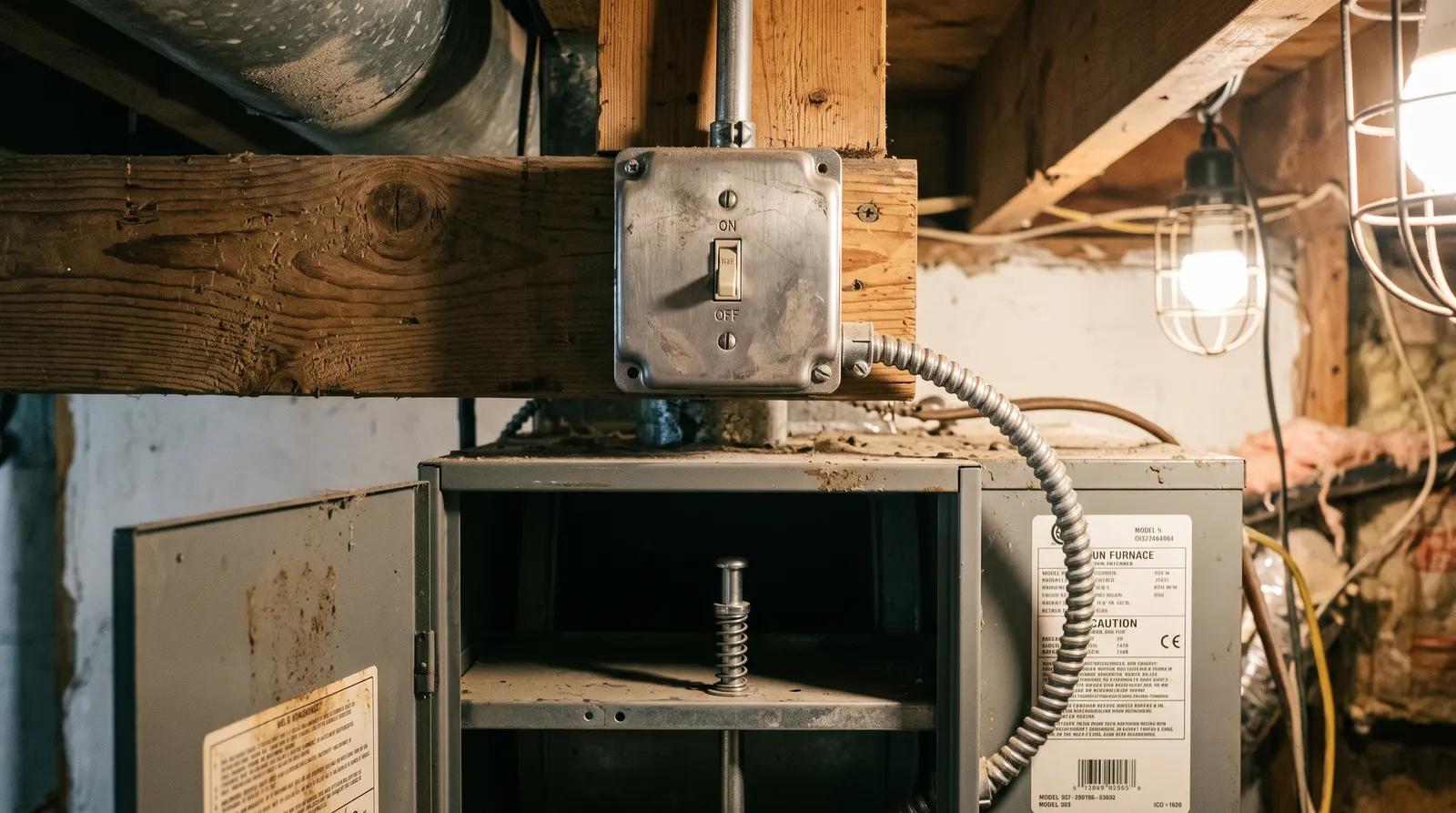
A switch that looks exactly like a light switch, on the furnace casing or on the wall beside it. It gets flipped by mistake constantly, and it kills the furnace completely.
03
The access panel
Behind the front panel is a plunger interlock switch. If the panel is not fully seated, usually after a filter change, the furnace has no power at all.
04
Breaker, then lockout reset
Check the furnace breaker. Then switch the furnace off at its own switch for a full minute and back on, which clears a control-board lockout.
The door switch nobody mentions
Behind the removable front panel of almost every modern furnace there is a small plunger switch. The panel presses it when properly fitted, and the furnace has no power at all when it is not pressed.
It exists so that the blower cannot run with the cabinet open. In practice it is the single most common reason a furnace goes from working to completely dead, because the classic sequence is: change the filter, put the panel back slightly proud, and discover an hour later that there is no heat.
Press firmly on the panel and listen. If the furnace springs to life while you are pressing, that is your answer and it costs nothing to fix.
The power switch that looks like a light switch
Somewhere on or near the furnace there is an unlabelled toggle switch, often in a standard wall box, that cuts power to the unit.
In basements it is frequently at the top of the stairs, which is why it gets switched off by people who assume it is a light. In attics and crawlspaces it is usually on the unit itself. It is worth finding it now and labelling it, because it is also the switch you use to clear a lockout.
What lockout means and how to clear it
When a furnace won't turn on after a few attempts, the word technicians use is lockout. Every competing page uses it and none defines it, so here it is.
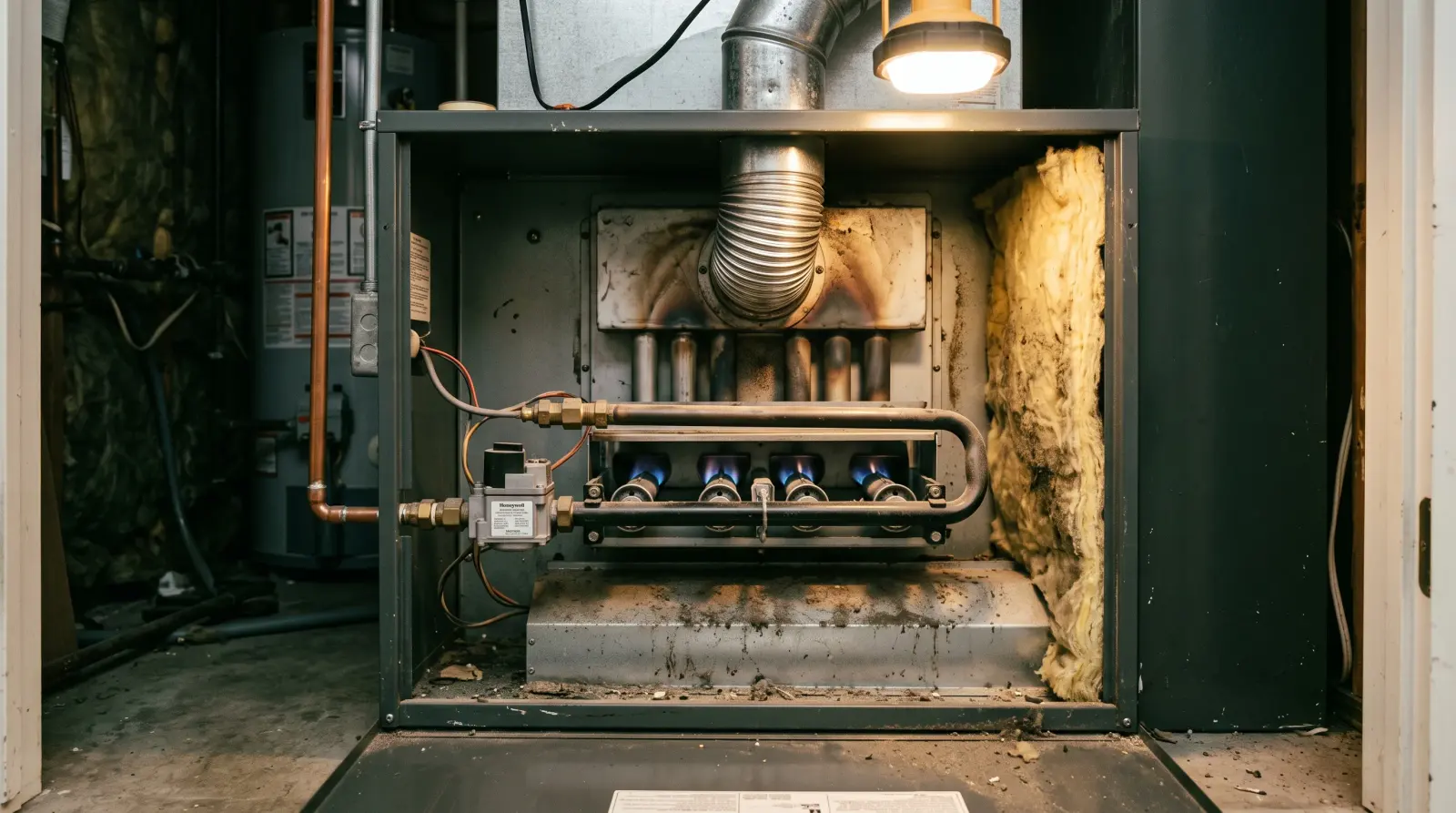
A modern furnace tries to light the burner, then looks for a flame with a sensor. If it does not detect one, it purges and tries again, typically three or four times. After the last attempt it stops trying and enters lockout, deliberately, to avoid filling the heat exchanger with unburnt gas.
Clear it once. Switch the furnace off at its own power switch, wait a full minute, switch it back on and let it attempt a full cycle.
Watch what happens. If it lights and runs, something transient caused it. If it locks out again, the fault is real.
Do not keep resetting. Repeated cycling of a furnace that cannot prove a flame is the one homeowner action that genuinely adds risk.
Common causes: a dirty flame sensor, a failed hot-surface igniter, a blocked condensate drain on a high-efficiency unit, or a blocked flue.
Reading the diagnostic flash code
When a furnace won't turn on, most units built in the last twenty-five years will tell you why, and almost nobody reads it.
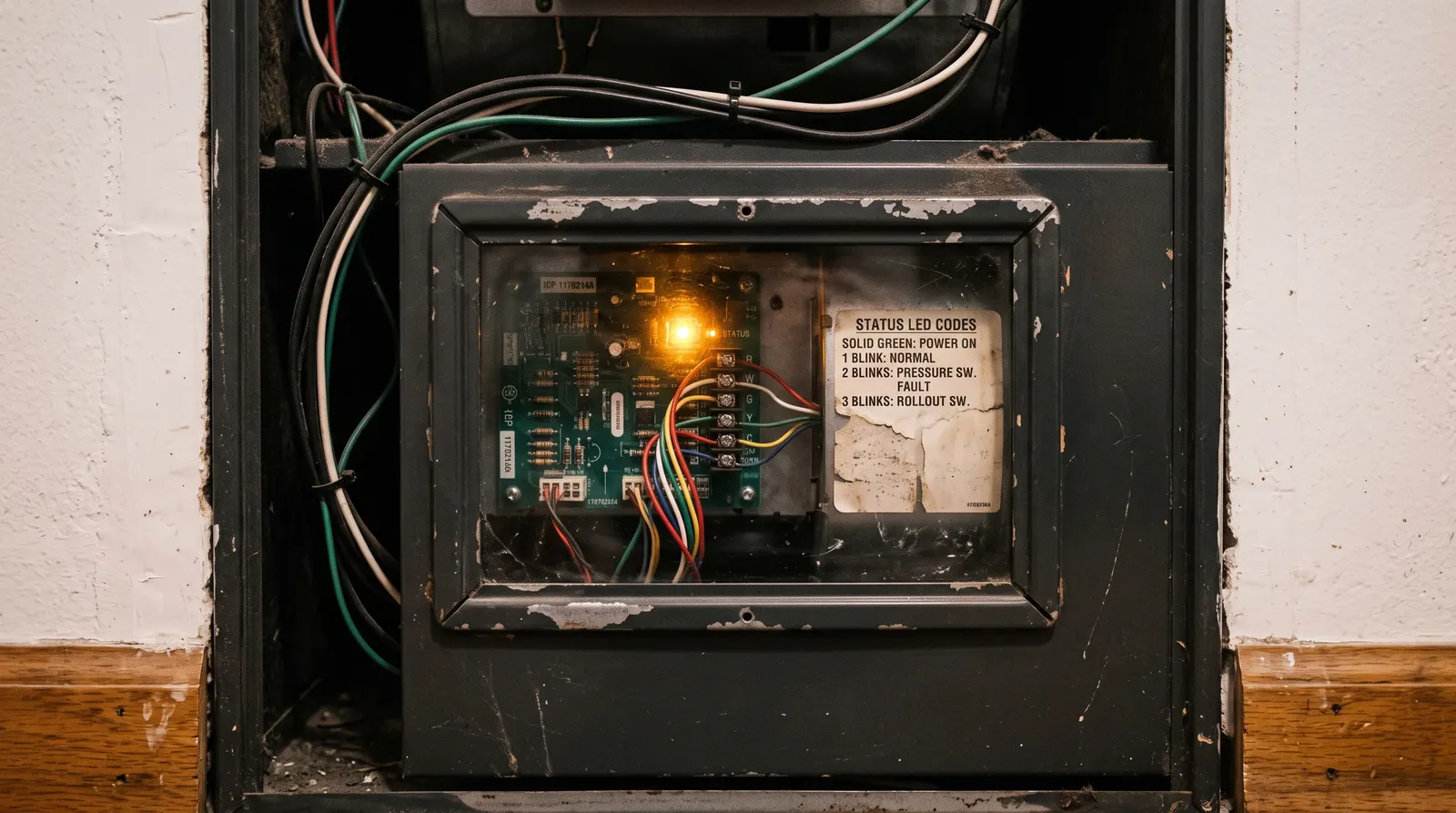
There is an LED on the control board, usually visible through a small window in the panel or immediately behind it. It flashes a pattern, and a legend printed on the inside of the access door translates that pattern into a fault: pressure switch open, flame sense fail, limit switch open, and so on.
Count the flashes, photograph the legend, and quote the code when you call. Technicians will tell you it regularly halves the diagnostic time, and diagnostic time is what the first hour of the bill is made of.
Is there a reset button on a furnace?
Where is the furnace reset button?
Most modern gas furnaces do not have one. Oil furnaces usually do, on the burner, and it should be pressed once only. On a gas furnace the real reset is switching the unit off at its own power switch for a minute.
This question dominates the People Also Ask block for this search, and the answer on most pages is a vague yes. The honest answer is that people are looking for a button that mostly does not exist, and the power switch is what they actually want.
On an oil furnace the reset button matters and so does the discipline around it. Pressing it repeatedly floods the combustion chamber with oil, which is a genuine hazard rather than a wasted attempt.
Getting through a cold night safely
If the checks fail and you are waiting until morning, the priority order changes. Pipes first, people second, because pipes cannot move to a warmer room.
Open cabinet doors under sinks on exterior walls, and let cold taps drip. That is standard freeze-prevention guidance and it costs nothing.
Consolidate. Close off unused rooms, and heat one space rather than trying to heat the house with portable heaters.
Spread the electrical load. Two 1,500 watt heaters on one 15 amp circuit will trip the breaker, which is how a cold night becomes a cold night with no lights.
Never bring combustion indoors. No generator, no charcoal or gas grill, no camping stove, and never the oven as a heater. That is precisely how carbon monoxide incidents happen.
Know the line
Safe to check yourself, or call a pro now?
Safe to check yourself
Thermostat mode, setpoint and batteries
The furnace power switch and the access panel seating
The furnace breaker
One lockout reset via a one-minute power cycle
Reading and reporting the diagnostic flash code
Call a pro now
Anything involving the gas valve, burners or heat exchanger
Replacing an igniter, flame sensor or pressure switch
A furnace that locks out repeatedly after a reset
Any gas smell, ever
A furnace that has triggered a CO alarm
24/7 dispatch network
Get a licensed HVAC technician moving on this
Checks done and still no heat, or a furnace locking out repeatedly. Send the flash code if you have it, plus your ZIP code, and licensed, insured HVAC contractors covering your area will contact you directly.
Fire, a gas smell, or an injury? Leave the building and call 911 first, then your gas
utility or power company. Use this form once you are safe.
Four free checks first: the service switch, the blower door interlock, the breaker, and the thermostat batteries. They account for a large share of dead furnaces.
What it costs if the checks do not fix it
Indicative US ranges. Always get a written quote.
Job
Typical range
Notes
After-hours diagnostic fee, weeknight
$150–$250
Before any repair work
After-hours diagnostic fee, holiday
$225–$500
Top of the band on major holidays
Emergency labor multiplier
1.5×–3×
Applied to the standard hourly rate
Furnace igniter, standard hours
$150–$350
The most common no-heat repair
Furnace igniter, after hours
$275–$600
$400–$900 on a holiday
Holiday furnace failure, documented case
~$1,180
Diagnostic, multiplied labor and parts combined
Source: 2026 emergency HVAC rate aggregator data; HomeGuide 2026 HVAC repair cost guide (retrieved August 2026). Figures vary by region, severity and after-hours timing.
Figures last checked
The igniter row is the one to note. It is the most common no-heat repair there is, and the spread between a standard-hours visit and a holiday call-out is roughly six-fold on the same part.
If the house is holding a safe temperature and pipes are protected, booking the first slot of the next working day is a legitimate several-hundred-dollar decision. Full rate structure sits in our breakdown of what emergency HVAC repair costs.
How the matching works, and what we do not do
Emergency Services 24H is a referral service. We do not employ HVAC technicians and we do not perform gas work.
Your request routes by ZIP code to licensed, insured contractors covering your area, and they contact you directly. Include the flash code if you managed to read it, because it travels with the request and shortens the visit.
Straight answers
Frequently asked questions
The questions homeowners actually search for on this problem, answered in plain language.
Switch the furnace off at its own power switch, which usually looks like a light switch on or near the unit, wait a full minute, then switch it back on. That clears a control-board lockout. If it locks out again after two or three cycles, stop resetting it and call a technician, because something is preventing ignition.
Is there a reset button on a furnace?
Most modern gas furnaces do not have one. Oil furnaces usually do, mounted on the burner, and it should be pressed once and only once. On a gas furnace the equivalent is switching the unit off at its power switch for a minute, which resets the control board.
What would cause a heater to not kick on?
A thermostat with dead batteries or set to the wrong mode, a furnace power switch that has been flipped, an access panel that is not fully seated against the door interlock switch, a tripped breaker, or a control-board lockout after failed ignition attempts. The first three are the most common by a distance.
How do I force my furnace to start?
You should not, and on most modern furnaces you cannot. The control board is refusing to ignite for a reason, usually a failed flame sense, a blocked flue, or a pressure switch that has not proved. Bypassing safety circuits on a gas appliance is how carbon monoxide incidents happen.
Why does my furnace lock out?
Because the control board tried to light the burner three or four times, failed to prove a flame each time, and stopped trying. That is a safety feature preventing unburnt gas from accumulating. Common causes are a dirty flame sensor, a failed igniter, a blocked condensate drain or a blocked flue.
What does the flashing light on my furnace mean?
It is a diagnostic code. Most furnaces have an LED visible through a small window or behind the access panel, and a legend printed on the inside of the door translates the flash pattern. Count the flashes, read the legend, and quote the code when you call, because it often halves the diagnostic time.
The service switch and the door interlock
Reading the diagnostic blink code
Ask for the blink code before the visit. A technician who knows the code often arrives with the part already on the van.
Tell us what has failed and where you are. We route your request to licensed, insured contractors covering your ZIP code, and they contact you directly.
Fire, a gas smell, or an injury? Leave the building and call 911 first, then your gas
utility or power company. Use this form once you are safe.